
Recent Articles
 Chapel Street Chapels11th July 2016
- Ormskirk: A Historic Market Town6th July 2016
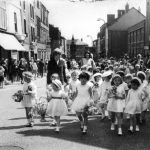 An Ormskirk Tradition: The Sunday School Anniversary Walks6th July 2016
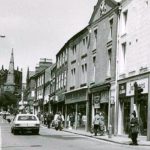 Riot At Ormskirk6th July 2016
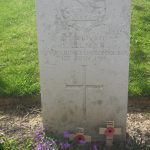 Ormsirk Men & The First Weeks Of The Battle Of The Somme4th July 2016
Top Articles

Arthur Fairbrother 1890-1916
Arthur Fairbrother 1890-1916

Arthur Fairbrother 1890-1916
Arthur Fairbrother was born in Chorley in about 1890. The youngest son of Amos and Jane Fairbrother, he spent his early years growing up in Chorley, before moving to Wigan and eventually Skelmersdale, where both he and his father worked in middle management for the Orm Weaving Company.
Arthur answered the call of his country in July 1915, joining the Royal Field Artillery as one of the many volunteer soldiers inspired by the recruiting campaigns that were famously spearheaded by Lord Kitchener. Assigned to 151st (Howitzer) Brigade the office worker turned soldier left home for training on Salisbury Plain, where he would stay until 29th November 1915, when an early morning start signalled deployment overseas.
The unit left Larkhill Camp at 4am bound for Southampton, where they would board the SS Inventor for their journey to France. It was on this voyage that Arthur got both his first sense of the danger he would face and the first taste of rations that he would, for the foreseeable future, be living on.

A page from the diary of Arthur Fairbrother written during 1915. Click for a larger view
“Left Southampton at 4.30pm,” he writes in his diary. “All men had to wear lifebelts during the voyage as a precaution should the boat be sunk or damaged by hostile ships. We were escorted by two torpedo boat destroyers who never lost sight of the valuable cargo of men, horses and arms.”
“On this day we made our first acquaintance with Army biscuits, but as we were hungry, we got them down with the aid of some so called tea, which, in my opinion was good water spoiled.”
The 151st Brigade spent the next two weeks marching across France to St Ouen and making preparations to take their first active role in the war, by the 16th they were ready to move into the ‘firing line’ for the first time. The unit spent the first six days in the firing line making improvements to the unfinished gun pits that they had inherited, before, on the 22nd, “we fired our guns for the first time in France, giving the Germans 70 rounds of 4.5 shells on their frontline trenches.”
The unit spent Christmas 1915 at the front, an experience that was far from the family Christmases many of the men at home had been used to. “We had stew for dinner and biscuits and jam afterwards. I think the cook must have forgotten the time, for we did not get our Xmas pudding until 3pm. However I think we all enjoyed the little bit we got, and we thanked the senders (Daily News) for the only reminder of Xmas we had in the foodline.”

Arthur Fairbrother’s sweetheart Wyn
On Boxing Day Arthur found the time to write to his sweetheart Wyn (Winifrede), who like many wives, girlfriends, mothers and fathers was anxiously awaiting news of loved ones from the front. His brief letter, written on what appears to be a blank receipt from a retailer in Paris, due apparently to a lack of writing materiel, can be seen pictured with this article.
The unit was pulled out of the front line on 28th December and enjoyed a relatively peaceful New Year, with the Officers putting on a show of sorts for the enlisted men. “At night we were ‘entertained’ by the Officers and had a good show under the circumstances,” writes Arthur. “Afterwards we adjourned to another room and held an impromptu concert and were handed oranges, cake, sweets, cigarettes and coffee. Under the circumstances it was a very good show.”

The letter written by Arthur Fairbrother to Wyn, Boxing Day 1915. Click for a larger view
On 10th January 1916 the 151st were once again ordered to the firing line, with positions being occupied on the 12th and their arrival being greeted by immediate fire from the German artillery. “We began to feel ‘quaky’ as it was our first time under enemy shell fire,” says Arthur. “However we got into the gun pits at about 8pm. A few minutes later a salvo came very near to where our horses were stood, shrapnel killed two horses instantly and one man was hit in head and legs, two others were blown out of their saddles – shock resulting- and it left us with three men in hospital.”
The unit would spend the next few months moving in and out of these positions, sporadically exchanging fire with German artillery and shelling the enemies front line trenches, although as in most places on the Western Front a large portion of Arthur and his comrades time would be spent digging, sandbagging and otherwise improving or repairing their positions, with work parties an almost daily occurence, as a typical diary entry from 20th April indicates. “Built our dugouts up again, and later in the day fired 50 rounds on an enemy battery. At night the enemy shelled well over our position.”

A pre-war portrait of Arthur Fairbrother
Of course these periods of relative quiet were punctuated by periods of intense activity, with the unit being called into action for a number of large scale bombardments. On 16th January for example the unit came under heavy bombardment, which Arthur describes vividly in his diary.
“They gave no mercy and we were like rats in a hole, some had not time to get to the ‘Bomb and shell proofs’ and took their chance in their dugouts, lying on the floor. I was in a dugout far away from the others which we used for writing. I got down against the thickest part of the side and lay with my blankets over my head. I was terrified, for no sooner did one shall burst, another burst nearer. lt was real agony, for shells were dropping 10 yds and nearer to the dugout. Shells kept coming over and renting the valley and any minute I was imagining one or two would catch me and I should have been no more.”

A newspaper article commemorating Arthur Fairbrother. Click for a larger view
On more than one occasion over the first few months of 1916 the unit was called into action to help repel German attacks and it must have come as a considerable relief to Arthur to have been granted leave back to ‘Blighty’ on June 3rd 1916. “After a very weary journey ‘Blighty’ was reached and in my particular case, ‘lovely’ Wigan came into view at 6.45pm 4th June,” he writes.
At this point in the diary Winifrede has written, “Arrived in Gathurst Sunday 5th June 3pm – to spend first leave from France.”
By now the 151st Howitzer Brigade had been reorganised and Arthur’s Battery had been reassigned to the 149th Brigade and it was to this unit that he returned after his leave. Arthur was present in the Somme region of France during some of the darkest days for the British soldiers on the Western Front and it was at Delville Wood on 15th October 1916 that he was killed during an artillery barrage.
Arthur Fairbrother is buried at Guard Cemetery, Lesboeufs, France along with over 3000 other men from Britain and the other Allied nations.

Guards Cemetery at Lesbouefs
A transcript of his War Diary was kindly donated to the Skelmersdale Heritage Society by Ann and Geoff Whalley, and it is with their kind permission that we have been able to retell Arthur’s story on the Ormskirk Bygone Times site, the original was donated to the National Archive and is held in their collections at Kew.
Ormskirk Bygone Times hold a considerable collection of information on many of the men, from Ormskirk and the surrounding area, who fought and died in both World Wars and we aim over the course of the coming months and years to tell the stories of as many of those men as possible.
Thomas Herbert Stretch – 28th Jan 1851 -25 Dec 1929
Thomas Herbert Stretch – 28th Jan 1851 -25 Dec 1929

T.H. Stretch
Thomas Herbert Stretch was born in January 1851 in Booth Kirkdale. His father, Thomas Stretch Snr, was a cotton broker who had served an apprenticeship as a clerk before marrying and starting a family.
By 1865, Thomas Snr. had moved his family to Burscough Street in Ormskirk and lived at Vine Cottage, the very last property before the Burscough Boundary.
From the first years of the Family living in the town they were very much involved with the local community and from as early as 1865 Thomas Snr was a director of the annual show for the Ormskirk & Southport Agricultural Society. He was also a winner of several prizes for his poultry entries, including ducks, bantams and his very successful Cochin China Buff chickens.

Champion Collie “Ormskirk Emerald”
Whilst Thomas Stretch carved a successful business career in the town and proved an expert poultry breeder and exhibitor, his sons became local sporting heroes and excelled at athletics and cricket.
In later years Thomas Herbert Stretch took over the poultry breeding and exhibiting and also entered the world of pedigree dog breeding, specialising in the Rough Collie breed, with which he found local, national and international success.
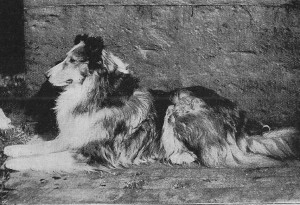
Ormskirk Christopher, the first collie ever to sell for over £1000
The Rough Collies bred from the Burscough Street kennels were of the highest standard for the breed and competed at Cruffs and at shows all around the UK. Thomas became the foremost collie dog expert in the World and his animals were supreme Champions. The dogs were almost always given names with the prefix Ormskirk.
The first Collie dog in the World to sell for £1000.00 was Stretch’s Ormskirk Christopher, which was sold to an American kennel and for several decades his champion dogs were exported to breeders all over the World.
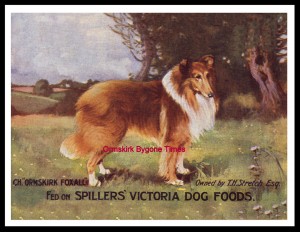
An advert for Spiller’s Victoria Dog Food, featuring Ormskirk Foxall, one of Stretch’s collies
As a show judge he had an unrivalled expertise and commanded respect for his knowledge and understanding of the Collie breed. He travelled to Scotland and Ireland to judge at shows such as the Perthshire Canine Society, the Forfar Poultry Show, Belfast Dog, Poultry & Pig Society show and the County Antrim Agricultural Association Show. That is besides the dozens of English County Shows he attended, both as a judge in Poultry and Collie dogs and as an exhibitor.
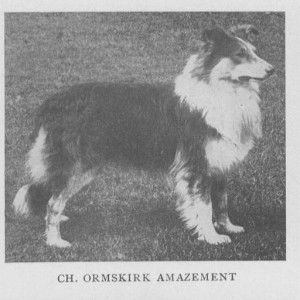
Champion Collie “Ormskirk Amazement”
One of his early successes as a breeder of Rough Collies was in April 1887 at the Warwickshire Dog Show, where his dog Sir Latham was awarded 3rd prize. In July of 1887 at the Chester Show, Sir Latham won first prize and a special silver cup award. In Belfast in 1891, his pair of Rough Collies, Ormskirk Paradox and Ormskirk Stella both won first place in the Dog and Bitch classes respectively, then in 1892, his Ormskirk Ormonde and Ormskirk Hilda took first prize in both their classes. In Dublin in 1893, Ormskirk Hermit and Ormskirk Memoir again won their class.
The Stretch family of Vine Cottage were a family with very close connections to many of the town’s noted families, for more information on the family please visit our group at https://www.facebook.com/Ormskirkbygonetimes
Coulton’s Bakery, Windmill Avenue
Coulton’s Bakery, Windmill Avenue

Coulton’s Bakery, which still stands today on Windmill Avenue
In 1901, Thomas Coulton (1870 – 1936) had a small grocery shop at 22 Wigan Road with a bakery at the rear owned by William Fryer. Thomas had served his apprenticeship with Ainsdale baker Robert T. Duerden but had been born in Halsall/Rufford.
The bakery was taken over by Thomas Coulton and the new factory was built in 1903 on Windmill Avenue. By 1911, Coulton, the Managing Director of the bakery, had moved his family into the large family home Blairgowrie, Ruff Lane, later to become the Nurses Home.

Blairgowrie, the house on Ruff Lane that was owned by Thomas Coulton and would later become the nurses home
Thomas travelled to the United States in the early 1920s to look at the mechanical processes used there in bakeries and his son Wilfred also travelled to North America in the 1920s as the Bakery Manager visiting factories in the Chicago area. Wilfred is recorded as travelling to the USA quite a few times in the early 1920s. On one journey he appears to have travelled with a Mr Warburton.

Machinery from Coulton’s factory on Windmill Avenue
Bakery factories in Canada were visited by Wilfred in 1921, the Harrison Wholesale Bread Baker factory in Montreal, and the Ideal Bread Company in Toronto, Ontario.
The Ormskirk Bakery business thrived and modern methods of production were brought into the factory. Local deliveries, domestic and commercial, meant that the Coulton Vans became familiar sights around the area, with the business expanding to a factory in the Southport area, where Thomas Coulton lived in the later years of his life.

A Coulton’s delivery van based at the Southport factory
Thomas Coulton took a keen interest in local civic matters and he sat on several committees at the Workhouse in Wigan Road during the 1920s.
If you have any of your own stories relating to Coulton’s Bakery or any of the other businesses in the town we would love to hear them, so get in touch with us here.

An advert for Coulton’s Purity Bread
The Iron Horse
The Iron Horse

Ormskirk Railway Station
The Railway reached Ormskirk in the 1840s and with its arrival a whole new world of opportunity opened up for ordinary people of the town. Everyday travel to work at all destinations to Liverpool and Preston meant that people were motivated to learn new trades and skills and this meant a change in income.
The type of housing being built in the town to accommodate the professional working class and the growing number of successful tradesmen led to the building of the towns own areas of superior quality housing. Many of these large detached houses are still standing today in the St Helens Road, Ruff Lane and later Knowsley Road, areas. Southport Road was also a part of the town which saw rapid development from a road containing old cottages and a busy rope factory to a well planned modern street offering larger homes to the business people living and working in the town.

New housing on Ruff Lane. Built as a result of expansion after the introduction of the railway to Ormskirk
The Railway also created a demand for hotel and Inn accommodation which in turn led to the renovation and extension of several town centre hostelries. The Commercial Hotel on Railway Road became a thriving concern for travellers and there was also carriage service there for travellers wishing to visit the area on business or pleasure.
Market Days were destination points for travellers from all over the County and indeed beyond and this swelled the towns population each Thursday and Saturday, bringing revenue to the town regularly and allowing many local businesses to expand and diversify. With the emergence of the retail concept in the latter half of the 19th century, shops in Ormskirk became bigger and better appointed with a wide range of stock on offer to visitors and locals, the range of market stalls began to change from farm produce and agricultural supplies to more domestic needs, like materials, clothing, footwear and even souvenirs for the visitors to take away with them.

a souvenir seller on Ormskirk Market
Ormskirk thrived with the new Railway connection and continued to expand and grow , whilst its local agricultural production increased with the new markets the farmers could reach using the goods trains into Preston and Liverpool.
If you have any of your own stories about the railway in Ormskirk we would love to hear them, you can get in touch with us here.
Mobile Phone?
Mobile Phone?

Taken this week by OBT follower James, this photo shows the relocated phone box adjacent to the clock tower.
Anyone strolling through Ormskirk this week would have been rather startled and taken aback by the sudden appearance of a red telephone kiosk adjacent to the Clock Tower. Heads swivelled as people passed the bright red obelisk daring to compete with the towering iconic stature of the town centre Clock.
It’s apparently not a permanent fixture and has shuffled across the street from outside the HSBC, where it had languished since the late 70s/early 80s. Quite where it had been before that has not been ascertained.
This particular kiosk is not as historically valuable as the grade 11 listed kiosk near to the TSB in Derby Street. The grade 11 listing was awarded because the Derby Street box is a ‘Jubilee Box’, so named as it was designed to commemorate the Silver Jubilee of George V and Queen Mary, our present Queen’s grandparents, in 1936. A gold Tudor Crown appears on all four sides of the kiosk close to the roof, although the gold painting of the crowns was a modern idea to accentuate the heritage value of these boxes, the crown was originally red.
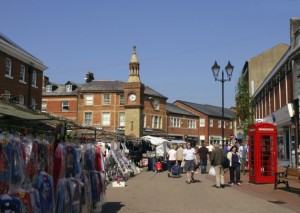
The previous location of the phone box outside HSBC
In 1953 Queen Elizabeth had all crowns changed to the St Edward’s Crown, the Coronation crown and the kiosk on Moor Street has this crown, dating it to around 1953.
Ormskirk’s growing modern population living on the new estates around the outskirts of the town relied on these kiosks as their main form of emergency contact. Home phones were not a common service in many homes in the 1930s, 40’s, 50’s and even 60’s. The town was well served for kiosks though, with town centre ones at the (old) Bus Station on Knowsley Road, on Moor Street outside what is now Middleton’s cycles, three outside the main Post Office and further out there were boxes on Tower Hill, near Hallsworth’s, Thompson Avenue, outside Pigott’s and Dyers Lane as well as on County Road near the Fire Station and Scott Estate.
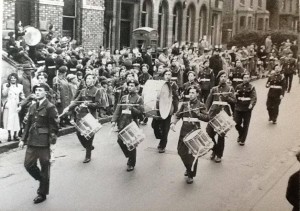
The Grade II listed kiosk on Derby Street can be seen in the background of this photo taken c. 1950
The essential service they provided meant that people have clear memories of the occasions when these kiosks played an important part in their lives whether it was ringing the midwife in the middle of the night, contacting the police in an emergency or just using it to ring school friends / sweethearts who were waiting outside their local box for a pre-arranged call.
Next time you pass your local kiosk take a moment to appreciate its iconic status and the role it has played in our developing world of technology.
Ormskirk Bygone Times have a mobile display available for any local group or event, the display covers a vast array of stories and histories of the townspeople and buildings
Before The Railway Came To Town
Before The Railway Came To Town
The Railway line was built in 1849 from Liverpool to Preston, passing through Ormskirk and from then on opening up a whole world of opportunity for local people to leave, or for strangers to arrive.
Before the railway came, people of the town had the choice of coach travel on various routes and the coaching inns ran a strict timetable.
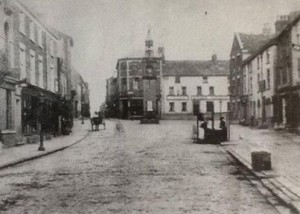
The original King’s Arms
In the early 1820s, the King’s Arms on Moor Street was the staging post for four very important coaching routes. Daily journeys aboard the ‘Invincible’ left Ormskirk at 6am for Carlisle, Glasgow and Edinburgh and then at 6pm for Liverpool. A coach to Leeds left the King’s Arms daily at 6am calling at Blackburn, Burnley, Colne and Keighley. The Royal Liverpool left at Noon daily for Lancaster where a passenger could change to the Lord Exmouth and travel on to Newcastle. The Liverpool coach left at 3 in the afternoon. The Royal Pilot ran to Manchester in Summer on a Monday, Wednesday and Friday at 11am.
The George and Dragon public house at the corner of Church Street and Aughton Street was also a busy staging post, with five established routes, The Mail coaches to Liverpool and Carlisle left at 8.30pm each day. The Telegraph Mail service ran to Kendal at 10am and to Liverpool at 6pm. The New Times ran to Carlisle at 6am and to Liverpool at 7pm. The Umpire left for Liverpool at 12noon and for Newcastle at 5pm. The Eclipse ran to Liverpool at 9.30am and to Southport at 5pm.
The Wheatsheaf in Burscough Street had a coaching route with The Amity leaving for Liverpool every Wednesday and Saturday at 7am returning at 7am the next day and a Sunday excursion to Southport during the summer at 8am returning at 8pm.
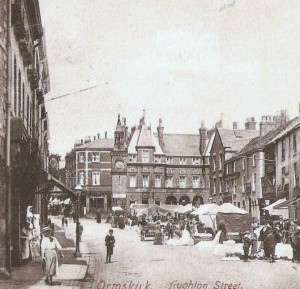
Aughton Street with the Talbot in on the left
By the late 1820s, a London Royal Mail coach was stopping off in Ormskirk at the George and Dragon every evening at 6pm, the established routes above carried on into the 1830s with the Talbot Inn introducing the Fair Trader calling from Liverpool daily at 1.30pm on the way to Kendal and the Royal Irish Mail from Lancaster calling every day at 4pm.
These established routes were starting to dwindle into the 1840s, the Ship Inn on Moor Street played host to the Southport to St Helens noon coach with The Victoria covering the Wigan to Southport route daily calling at the King’s Arms at 9.45am and returning at 5.30.
By 1855, there is just one route still in operation, a coach from the Railway Station, calling at the King’s Arms at 11.15 on it’s way to Southport and returning at 4.30pm.
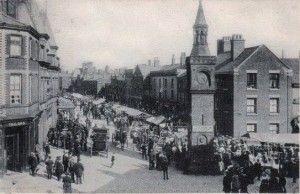
A busy clock tower with a coach outside the King’s Arms
By 1869 all the routes have ended. The Railway took the trade. Faster, cleaner, probably more reliable, though this is hard to say.
Ormskirk Bygone Times have a database of all the towns pubs if anyone has an interest in the history of trade in the town.
Tower Of Power
Tower Of Power

The water tower as it stood originally with the large water storage tank on top
The Victorian Water tower that is so familiar to every generation in the town from 1853 onwards, dominates the Ormskirk skyline still, despite the removal of the original water tank some years ago. There was a viewing platform on the top from where you could see the Victoria Hotel in Southport, Parbold Hill, Rivington Pike, Harrock Hill, Hunter’s Hill, Ashurst Beacon, Knowsley Hall and Liverpool in the far distance. The access to the viewing platform in 1853 was via an iron tube running through the water in the tank.
Built to save the town from disease and deterioration, the tower had a massive impact on the health of everyone in the town from the first day it went into operation.
From October 1853 the water system in the town was operational and fed from a 226ft well which was sunk about 300 yards from the tower near to Bath Springs, where a public bath had been in use but had closed prior to the Tower being built. A powerful pump forced the water from the spring/well to the tower.

The water tower as it stands today, the tank having been removed after it went out of use in 1976
The Tower itself was sited to the North East of the town with open fields around it, there were no houses close by until Sgt Major Nunnerley built Inkerman Lodge almost directly opposite. The original area around the Tower was used for grazing cattle and sheep viagra en pharmacie sur ordonnance. The road had been known as Tinker’s Hill for generations but when the Tower was built it became Tank Lane. In the 1920s, it was voted by the council planning committee to rename it Tower Hill.
The water supply from the well served the town’s needs adequately in the first twenty years, but with the increase in population by 1876 the water table had sunk below the foot of the well on a number of occasions and supply was looking to be a problem.
Mr Mansergh, at the request of Central Government and on instruction from the council undertook a detailed study of the whole system in January 1876. His report, dated May 1876, confirms that the 226ft well used from the installation in 1853 was indeed becoming unreliable. A second well 60 feet deep had been sunk and had been used to pump 230,000 gallons per day for domestic, trade and railway supply. It was clear in his report that the 20 year old system drastically needed an upgrade.
His report recommended that a Davey Compound Differential Engine be bought with a pair of single-action lifting pumps in a purpose built pumping station, the expense of installation and housing of this new system Mansergh assured the committee, would be less than replacing the beam engine currently in use, with the capability of pumping 200,000 gallons in 12 hours.
The Tower remained in service to the town for a further 100 years and in 1976 it was awarded Grade II listed status. The abandoned tower lost the huge tank from the top and remains as a reminder of the ingenious engineering and foresight used in Victorian Times to improve the lives of ordinary people.

An article from the Ormskirk Advertiser, published when planning permission was rejected on the tower for the seventh time. Click for a larger view
Several attempts to develop the building into commercial and domestic use have been submitted to the local planning and each one has been rejected, the building is once again on the market.
Other towns with similar Victorian Water Towers, have formed support groups to press for the restoration of their towers to celebrate the ingenuity and sheer skill of the people who built them and got them to work so well.
If you have any personal memories of the tower, whether working there, playing there (carefully and never climbing the interior spiral staircase to the viewing platform), swimming in the tank, (thought that was more in Ruff Wood) or wish to form such a group, please get in touch.
A Moving Story
A Moving Story

The drinking fountain that remains in place on the Derby Street railway bridge
In 1858, local benefactor, R. Hardy Wrigley, donated 2 drinking fountains to the town of Ormskirk. They were elaborate red sandstone bowls, positioned beneath an apex roofed portico. One fountain was sited on the corner of the then newly re-built Derby Street Railway Bridge, and the other was positioned on the bridge over the brook at the corner of Dyers Lane and Aughton Street.
The one we will all know, on the Derby Street Bridge, has a metal lions head spout. An oblong plaque was placed with the fountain naming the benefactor and the date 1858 was placed below the Apex. The one on the Derby Street Bridge is still there along with all the original detail. It is also a Grade II listed monument. As is the fountain in the St Helens Road Park. But the mystery here is, where did the Aughton Street bridge one go? There are people who can recall the Dyers Lane Fountain, but does anyone know why it was removed or where it was sent to?

An article from the advertiser containing details relating to the clock tower. Click for a larger view.
The original design of Ormskirk clock tower in 1876 by Mr Balmer included drinking fountains fronting Church Street and Moor Street and a commemorative slab fronting Aughton Street. The full description of the Clock Tower construction is quite detailed.
So the clock had it’s own fountains from 1878, the Derby Street Bridge and Aughton Street Bridge had their own fountains from 1858.
The Lions head spouts on the clock tower fountains were added to all the fountains in 1998 by the WLDC. When and why were the plaques removed from the clock tower? Or are they re-sited somewhere? Did WLDC add the lions head spout to the railway bridge fountain in 1998 too?
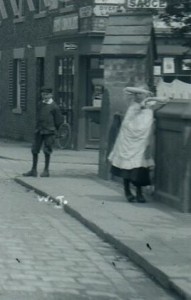
An old photograph showing the location of the drinking fountain on the corner of Dyers Lane
Our photographic evidence for the twin fountains donated by Mr Wrigley shows the exact positions, could the history of flooding on Dyers Lane have led to the fountain being removed/relocated? Was the water supply to these fountains from an artesian well and the water table re-routed to the fountains?
The description of the clock tower from 1877 does not match the current photos, the fountains appear to have been moved at some point.
We have many photos of the Clock Tower over time and many images of the Derby Street Bridge but we think we have the only image of the Dyers Lane Bridge Fountain in our collection of original glass slides.

A comparison showing the drinking fountains on the clock tower as they were and as they are now
If you have any clues to the missing fountain’s whereabouts, please get in touch, we would love to hear from you.
Let’s see if we can solve this mystery.
Time In A Bottle
Time In A Bottle
Ormskirk’s history is being preserved and displayed by Ormskirk Bygone Times and many of our friends, through a myriad of media and artefacts. One relatively inexpensive, and quite simple way that this is being done is by the collection of discarded bottles, storage jars and other empty vessels, long since emptied of their contents.
Image 1

Image 1. A selection of glass and earthenware bottles from Ormskirk businesses
The first image is of a group of rescued glass and earthenware bottles and vessels that covers a vast array of manufacturers across the decades, all with links to the town. From left to right:
Richard Taylor, Brewer of the Wheatsheaf Hotel, Burscough Street. Bottles like this were sold through the off license hatch to the side of the old pub way back into the early 1900s.
The Sterling Manufacturing Company of the old factory on Bridge Street produced a range of household cleaning products in the 1940s and 50s, including bleach, distemper and oils.
The partnership of Ellis, Warde & Webster based at Bath Springs brewery on Derby Street, originally built by Philip Forshaw mid 19th C., supplied many pubs across Lancashire and were a huge business in the town.
Woods Dispensing Chemist, 9, Church Street. William Beaconsfield Woods had been an apprentice to his Pharmacist father who was probably working at the dispensary in Burscough Street in the late 1800s.
Ellis Warde & Co Ltd. Originally brewed their ales at the Snigs Foot before merging with Daniel Websters Brewery from the Malt House Southport Rd and moving to Derby Street
Hyde’s wine and spirit dealers had a couple of premises along Aughton Street late 1800s into the early 1900s but along with the licensing restrictions on pubs at the start of WW1, retailers of beers and wines were also hit and the Hyde family moved to Liverpool.
Image 2

Image 2. A pair of bottles from Knowles Brewery
Two bottles recently dug up locally, these came from the Knowles Brewery, operating from behind the Snigs Foot, Church Street. Richard Knowles announced his venture into brewing on the front page of the Advertiser in September 1904, when Ellis & Warde moved their operation to Bath Springs.
Image 3
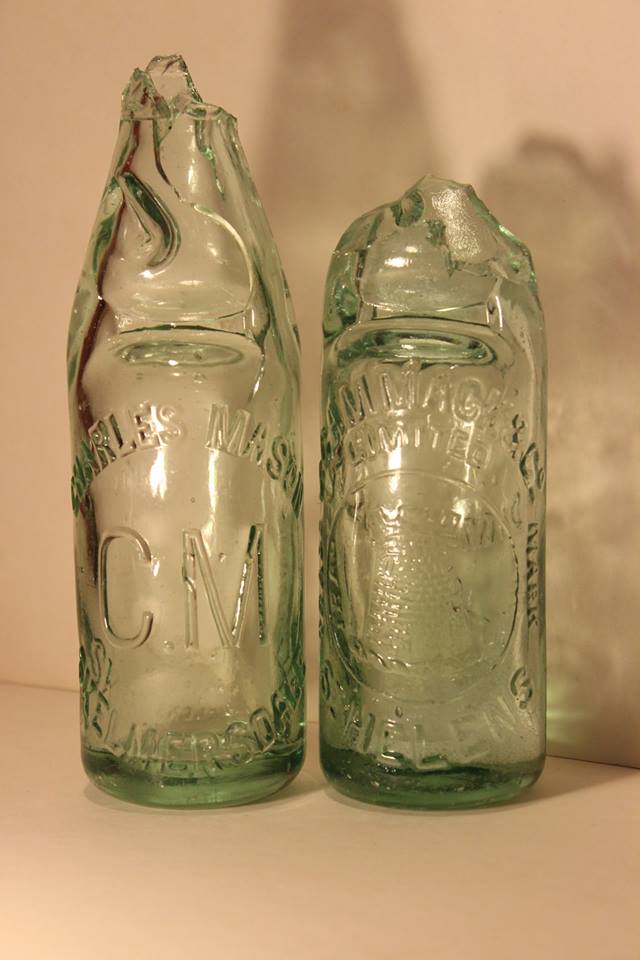
Image 3. Mineral Water bottles from Mason and Cammack
Mineral Water was big business in the town in the late 19th early 20th century. It was clean, safe drinking water and these two examples are from the firm of Charles Mason of Skelmersdale and George Cammack of Ormskirk & St Helens.
Image 4

Image 4. Disposable Inkwells found in the fields around Ormskirk
This type of throw away clay inkwell surfaces regularly in the fields around the town. Thrown into middens in Liverpool City in the 19th century and transported out of the city on canal barges buried in the rich natural fertiliser West Lancs built it’s agricultural industry on. Clay pipes have been ploughed up in the fields around Ormskirk for decades and sometimes they are still lit……
Ormskirk Bygone Times would like to say a special thanks to David Pye, our local bottle expert, who regularly attends our displays and spends a lot of time identifying all manner of vessels relating to local businesses.
Take A Seat
Take A Seat

A recolourised image of the Regal Cinema from the OBT archive. Thanks to David Pye for his excellent recolourisation work
There are people in this World who still dig for gold and there are people who buy lotto tickets every week in an attempt to make their dreams come true. Ormskirk Bygone Times’ heritage hunters just strive to seek out, rescue and repatriate lost artefacts from the town.
This week the hunt was on for something seemingly lost from the town forever but with some spot on research and some cunning detective work worthy of Columbo himself, something beautiful, rare and dripping with nostalgia was brought back to the town.
A row of five original art deco seats from the Regal Cinema, Church Street, has been bought and returned to Ormskirk by the team.

Rows of seats from the Regal Cinema that have been in the possession of a church in Liverpool
With peacock blue crushed velvet, silver trimmed covers, deep sprung seats and distinctive silver panels at the end of each row, the 800 seat lower stalls and 300 seat balcony must have seemed like a palace to cinema goers in the town.
The cinema, with its ruched metallic curtain across a wide panoramic screen, officially opened February 10th 1936, although the Ormskirk Amateur Operatic and Dramatic Society had used the venue for a performance of the Yeoman of the Guard in January .

The art deco style detailing on the seats from the Regal Cinema
The Cinema was designed in the art deco style with elaborate features and rich colours that mimicked the glamour of Hollywood Hills. The foyer was decorated with blue woodwork and doors with silver metalwork which must have looked very glamorous. A concierge was employed at the entrance complete with cap and uniform, quite probably in livery matching the blue and silver colour scheme. The Regal closed on November 23rd 1963 (the Day after JFK was assassinated) and for a short time it was used as a bingo hall and the seats were still in place.
We have a photo of the remodelling of the frontage from 1963/64 when it became a supermarket, prior to Tesco taking over. In around 1965, the 1100 seats were removed and presumably split into lots for sale. OBT was able to track down one lot of around 100 seats which had been bought by a Liverpool Church and have been in use in the Church ever since. The seats recently once again came up for sale and OBT have purchased the row of five, and will hopefully acquire a further set of 5, to make a full row of 10, over the next few months.

Don’t take her for granted, take her to the Regal Cinema! An advert for the Regal Cinema. Click for a larger view
It is anticipated that this will be a great feature for our mobile displays in the future and people will be able to have their photos taken sitting in the seats that they fondly remember from their youth!
If you have your own memories of the Regal why not get in touch and share them with us!