
Recent Articles
 Chapel Street Chapels11th July 2016
- Ormskirk: A Historic Market Town6th July 2016
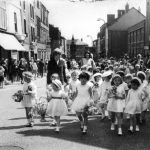 An Ormskirk Tradition: The Sunday School Anniversary Walks6th July 2016
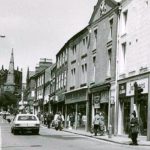 Riot At Ormskirk6th July 2016
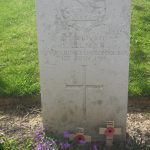 Ormsirk Men & The First Weeks Of The Battle Of The Somme4th July 2016
Top Articles

The Troqueer Building: Grand Town Residence To Labour Party HQ
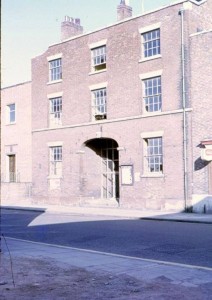
The Troqueer Building
Troqueer was a small settlement on the East side of Aughton Street that in the mid-1800s housed a huge Irish Immigrant population, all crammed into an area of small courts containing rows of tightly packed, hastily constructed cottages. St Patrick’s Court, situated between the Black Horse Inn and the Victoria Inn (later the Queens) was almost exclusively for the Irish Agricultural labourers who came into the town to find work they were familiar with.
Looking at the 1851 and 1861 census returns for St Patrick’s Court, there are dozens and dozens of children, all under 10 years old, all born Ormskirk and without exception, both parents are recorded as born Ireland. The Irish Agricultural Labourers were welcomed to the town, the Railway had brought them in after having enticed many local agricultural labourers into jobs on the railway and the trade the railway subsequently brought into the town meant that for local workers, other job opportunities other than working in agriculture presented themselves.

A Map Of 1892 Showing The Location Of The Troqueer Building. Click For Larger View
Moving northwards beyond St Patrick’s Court, and its accompanying beerhouse , the buildings change to the grand first residence, before he moved to Ormskirk Hall, Burscough Street, of Dr Charles Price Symonds, the Yorkshire born surgeon, who, on moving to Ormskirk to set up his practise in the late 1840s and married a local girl, Martha Stockley, in 1850, before opening his first surgery in a large house with landscaped gardens to the rear and adjoining on its north side the the large double fronted town residence of retired Pwhelli born landed proprietor, Hugh Owen, which as early as 1851 was named on town maps as the Troqueer Buildings. Hugh Owen lived there as far back as 1841, being listed under, ‘Nobility, Gentry and Clergy’ in an 1848 Slater’s Directory. Although 20 years earlier he had a tinplate works in Market Place. Hugh Owen died aged 83 in 1856 and was buried at the Parish Church on 7th July that year.
After Owen’s death, his son Richard Owen inherited Troqueer and moved in there with his family. Richard Owen was an ironmonger with an ironmongers and small foundry on Moor Street next to the King’s Arms, which later, when Richard Owen retired to Scarborough after 1871, became Wainwright’s Ironmongers and then the Corn Exchange.

A Cammack Mineral Water Bottle
Troqueer saw changes during the 1870s and was split into a smaller residence for Henry Hydes, the wine and spirit merchant, with some of the rear of the property being made into a court for separate small dwellings, when Hydes moved across the road to 32 Aughton Street to open a wine merchants shop, Troqueer was bought by George James Cammack, the Mineral Water Manufacturer who ran the business with great success for several decades from those premises. The Water Manufacturing business was huge at that time as bottled mineral water was a safe and healthy option to pump water. Remains of the factory we believe still exist to the rear of Aughton Street across to Bridge Avenue.
George James Cammack only moved from Troqueer between 1916 and 1919. The next information we have is that the building became the Labour Party Headquarters in the town and was used as the campaign HQ for the Ormskirk candidate 28 year old Harold Wilson in 1945. Wilson served as the Town’s MP from 1945 until 1950.

An Advert For Cammack Mineral Water. Click For Large View
The descriptions of the grand interior court of Troqueer mention large black marble columns and huge black painted doors. The building was demolished in the 1970s and remains as the telephone exchange car park. If anyone can add anything, or indeed correct any of this research, please do get in touch.
An Ormskirk Record
An Ormskirk Record
Dot Broady-Hawkes shares her recollections of the many and varied record shops that have served Ormskirk in for many generations
A gramaphone record bought from F Rudd’s on Derby Street West
Frederick B. Rudd of 16 & 28 Derby Street West had one of the first businesses in Ormskirk to sell Gramophones and Gramophone Records. Formerly a Musical Instrument Dealer in the early 1900s, the post WW1 boom in the sale of the Gramophone and 78rpm records meant Rudd’s little shop at No 28 must have been packed with a vast range of recordings. Amazing to think that 50 years later the same premises was re-opened as the first Soundsgood store in the town. The tiny shop again was packed with the latest hit records from the Top Ten as well as an eclectic mix of teenybop, progressive rock, classical and middle of the road music. Genres that seem to sound quite strange now!

An advert for Allsets. Click for larger view.
Allsets in Burscough Street was a busy store in the 50s and 60s, selling the new vinyl long playing (LP) records and the very best music centres and radiograms available. The small but very well stocked record department in the back of the shop was a magical place in the 60s and the soundproof booths were just the best!
Woolworths did not always have a record department, only opening one in the early 70s but with centralised buying and distribution it did not have the vision to be adventurous in the stock holding and risk something new. Ormskirk had a large Student population even then and although they were all poverty stricken most of the time, they seemed to always find the money for the latest Yes or Pink Floyd album. It was always easy to tell who was a student by the way, they called an LP an ‘Album , just to show they were hip………

The original Soundsgood store in 1971
Soundsgood, which moved to 28 Burscough Street in October 1975 and Allsets provided top 40 chart singles and a superb range of music, with cassette tapes and the amazing unreliability of 8 track cartridges. The link between a biro and a cassette tape is something only that generation understand.
Will Parker Records began in the first floor of 56 Aughton Street, with the Farmer’s Union office below. It was cut price records without losing the choice. A busy store that eventually moved to the Bus Station end of Moor Street.

The new Soundsgood store in 1978
After these stores were gone along came Quirk’s Record Centre in Church Street which was a hugely successful business.
The days of independent record stores are sadly pretty much gone with the new technology and new media. We can only sit and look at our old LPs and promise ourselves that one day soon before our children take them to the tip we will buy a turntable and speakers and play them all again, just to hear how the music used to sound.
Ormskirk In Deed
Ormskirk In Deed
Property in and around Ormskirk has constantly changed hands for many years. Prime commercial sites at The Cross and along the four converging thoroughfares were valuable pieces of real estate with huge potential. Further out from the centre of town, small areas of development created their own importance to the town.

“Doctor Suffern’s House” that was located on the corner of Lydiate Lane and Burscough Street
One such iconic property was the large, street fronted, 9 room house known for many years as Dr Suffern’s house, (He had started his practise in Railway Road) which was situated at the corner of Burscough Street and Derby Street, where the police station is now.
Ormskirk Bygone Times has acquired an original Indentured deed for this property dating back to 30th April 1821. An Indentured deed was a transfer of title written out twice by hand onto a large sheet of paper, the large page was then cut into two parts, a top part and a bottom part, with the indented cutting edge perfectly matching at the join, this was to avoid any attempt of forgery.

The deed acquired by Ormskirk Bygone Times and relating to “Doctor Suffern’s House”
The property is described in the deed as being “at the west corner of Lydiate Lane and in part to the front of Burscough Street…”. Derby Street was originally known as Lydiate Lane right into the 20th Century. The size of the building is recorded as “containing in front to the said street twenty two feet five inches and to the said lane thirty five feet, eight inches more or less..”. The picture of the house shows the side view of the property and this matches the dimensions given in the deed quite clearly.
The owner of the house had been James Moorcroft, he had died and his nephew, Robert Moorcroft had been left as a trustee of the estate. Robert Moorcroft had however died before the estate could be settled and his own executors were left with the responsibility of disposing of the house. The executors were Henry Sharples, Gentleman and John Travis, Butcher, who were signing over the deeds to Thomas Hancock, Surgeon. There was a tenant in the property, Mrs Sarah Astley.

A map showing Butchers Row and the location of Dr Suffern’s House. Click for larger view
The Deed also covers a property across the lane, a dwelling house at the start of Butcher’s Row, which was in the tenancy of Edward Houghton. The ownership of this property is recorded in the deed as the “ inheritance of John Tatlock more late of Richard Tatlock afterwards of Richard Johnson in light of his wife afterwards of James Guest more late of Thomas Helsby…” Thomas Helsby then sold the property to James Moorcroft who then owned both sides of the Lane at its junction with Burscough Street.
The property in Butcher’s Row was adjoining the dwelling house that was being used as a public dispensary, this was before the purpose built dispensary building was founded by Dr Brandreth in 1830. (Now the Farmer’s Club).
The large house was still standing into the early 1960s, the adjoining properties to the front of Burscough Street were 3 storey houses but with no inside bathroom and they had become damp. The families were moved into Local Authority Housing and the whole block was demolished to make traffic flow easier at the junction and also to create a much needed car park.

A later view of the corner of Burscough Street and Derby Street where “Dr Suffren’s House” once stood
This part of the town at one time saw some wonderful buildings, Knowles House opposite, demolished to build the library, Waveney House at No 3 Derby Street, once the Miss Valentines School for Young Ladies. The Walter Brown building across the corner still remains.
Ormskirk Bygone Times now has four original deeds dating back to the early 1700s relating properties in the area. They are always displayed at our public events and always draw a lot of interest.
The History Of Coronation Park
The History Of Coronation Park

The modern entrance to Coronation Park
To mark the Coronation of King Edward VII in August 1902, plans were begun in Ormskirk to build a Public Park from public and private subscription along with a sum from the UDC coffers. The plan was to build on land that had previously been known as ‘Old Pants Rope Walk’ (Map 1, 1851) and had included allotments and orchards, the park was to cover a 20 acre site behind the Aughton Street Gas Works.

Map 1. Click for large image.
The Earl of Derby had been one of the main subscribers to the building fund. Initial access was via a rough track from Aughton Street running alongside the old Black Bull pub. (Map 2 1908). Within a short time the access track was adopted by the Urban District Council and named Park Road.
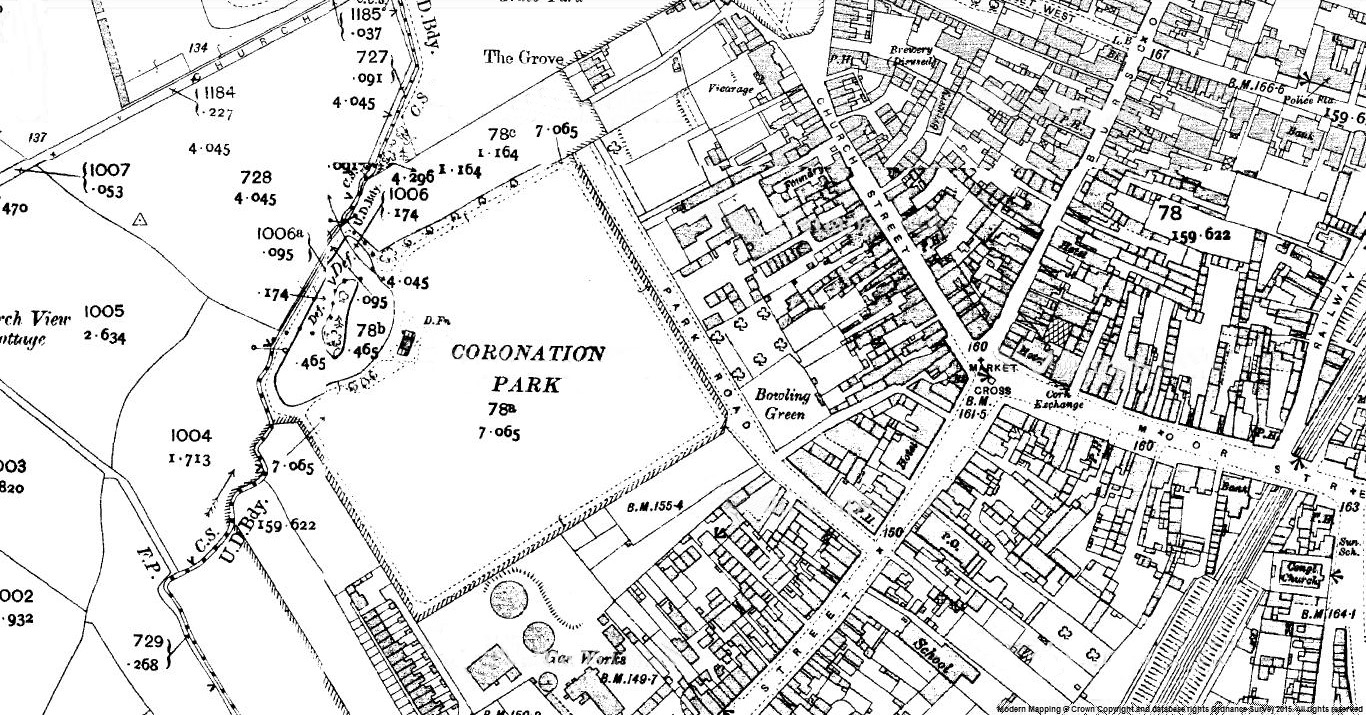
Map 2. Click for large image
The park construction had begun in 1904 and in August of that year a reward was offered by Town Surveyor Hugh W Chadwick in the sum of 10 shillings to ‘any person giving such information that will lead to the conviction of the person or persons who have smashed the Iron Check Valve in the lake in the Coronation Park’
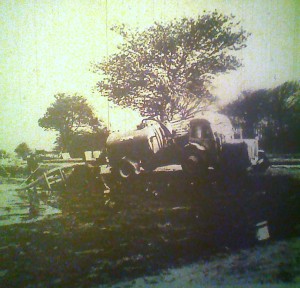
The Coronation Park Lake being drained in 1969
The lake was fed by a sluice gate letting water in from Brook Acre and on several occasions over the years the lake has been drained and cleared of sludge and debris. The main type of fish used to be roach though most children will more likely recall sticklebacks, jam jars and fish nets from Mansergh’s shop being linked to the lake.
The Park was unceremoniously opened to the public on 14th June 1905. The public had already started using the park but delays in arranging an official opening date were caused by the UDC being unable to obtain a date when Lady Derby (Constance Lathom) could commit to attend the opening. Conscious of the increasing frustration of the town ratepayers and in a concerted effort to justify the delay, the Clerk to the Council Fred C. Hill (Frederick Charles Hill, Solicitor of Square House, Lathom) had made his correspondence with Lady Derby available to the press. On April 28th 1905 he had written to Lady Derby appealing for her attendance at an opening ceremony before the end of May. On May 2nd Lady Derby replied from her London Residence, Derby House, St James’s Square , S.W. and assured the UDC that ‘We would like very much to be able to accept your invitation to open the new Park……Yours Sincerely, Constance Derby‘ Fred Hill duly replied directly on receipt of Lady Derby’s letter, informing her in his letter of the 4th May that ‘Wednesday is the usual half-holiday in Ormskirk and would be most convenient to the inhabitants for the opening of the Park’. He then went on to suggest either the 31st May or failing that the 24th May.

An old postcard of Coronation Park looking towards the Parish Church (1940s)
A full 6 days later Lady Derby replied from Holwood Hayes , Kent, ‘I fear we must give up the idea of being able to accept your kind invitation because we have so many engagements in the South during these next two months….’
The matter of the official opening was then debated at the meeting of the UDC on Tuesday 6th June, when the Chairman Mr F. A. Jones (Frederick Aneurin Jones, deputy County Coroner and Solicitor of ‘Glenridding’ Ormskirk)invited the opinions of the committee regarding the opening of the park without ceremony. Committee member Mr W. Fyles (William Fyles, House Builder of Knowlsey Road ) remarked. ‘The sooner it is opened the better , as people seem to be impatient for the opening’. Mr J. Peet (probably retired farmer from Wimbrick Farm, Joseph Peet) remarked that, ‘They (The public) were making use of it already, There were a large number in it on Sunday night.’. Mr T. O. Williams commented , ‘ Seeing that the negotiations with the Countess of Derby had fallen through I proposed that the Park be opened by our respected Chairman’s wife on Wednesday next, the 14th inst.’. Mr Williams, (the Aughton Street Tailor) went on to remark : ‘People are clamouring for the opening …’ The Chairman, Mr Jones felt sure his wife would be honoured to have been asked but also felt she would decline the honour, it was put to the vote that the Park be opened on Wednesday 14th June ,’…without any formality whatsoever…’.
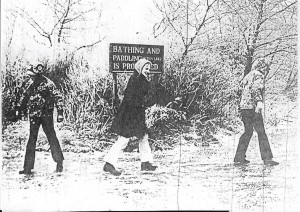
Children walking on a frozen Park Pool Lake in Coronation Park
Apart from the turfed areas, pathways and the lake, ‘thirty garden seats’ were provided ,which were made and supplied after tender by J.J. Balmforth of Aughton Street.
When the Bowling Green behind the old Black Bull pub closed it meant there was no green close to the park and plans were started to bring a green and other recreational amenities to the park.
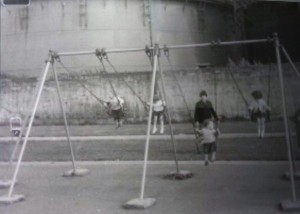
The swings at Coronation Park
The Park has had various alterations and additions over its 120 years. During the 1920s a pavilion was added overlooking the lake with a public drinking fountain close by. It was not until post Second World War that the Bowling Green, Putting Green and Tennis Courts were added. Two blocks of public conveniences were also added, one near to the main gate and one where the old pavilion had been. A new Pavilion was sited adjacent to the Bowling Green.
There are pictures showing a set of swings in the corner of the park near to the exit onto Vicarage Road , the main recreation facilities, i.e. swings , slides, roundabouts and the dreaded witches hat, were all set out in the corner at the Park Avenue entrance in the late 50s/early 60s.

Children playing on the Coronation Park slides c. 1971
There were two slides put in for children, a big one and a really big one. The really big one was the cause of more than one accident!
Many people will remember a local character Sam Pealing , who for around 15 years was the caretaker at the park who reserved your tennis court, issued you with your pitch and put iron or shouted at you for jumping in the lake.
One of the most popular and well used features added in the late 60s was the huge drainage pipe craned into position near to the concrete sand pit next to the lake. Remembered fondly by many people it was the simplest idea but a huge success. Until of course it became a hazard.

An advert for the Gymkana held on Coronation Park in 1952. Click for larger view
In 1952 the park was the venue for a Gymkhana that attracted 5000 visitors. The Summer Holiday Play Schemes were attended by hundreds of children who sat on the grass throughout endless punch and judy shows in the hot summers of the 1970s, not a drop of sunscreen in sight. The park continues to host events that need a wide open town centre accessible space.

Comrades Cenotaph
The Comrades Cenotaph was relocated to the park in the last few years and beneath this is a time capsule . The name of each man lost in the Great War, that was originally skilfully handwritten on a paper Memorial and used to hang in the old club, is being added to a plinth which will be placed alongside the Cenotaph later this year and form a real focus for those wishing to remember local men who gave their lives during the Great War.
Burscough Street In Old Photographs
Burscough Street In Old Photographs
Alfred Wragg had trained as an apprentice photographer in Bury and then Ormskirk from the 1880s under his father Herbert, as had Alfred’s older sister Caroline and younger brother Herbert Jnr. Caroline set up her own photography studio on Mesnes Street in Wigan in the 1890s and Herbert set his up in Church Street, Leigh. Alfred took over his father’s business at 30 Burscough Street. Alfred’s skill with the photography equipment meant he was not restricted to studio work and during his career he took hundreds of pictures in and around the Ormskirk district, recording a moment in time of a street or building. For this we will be forever grateful.
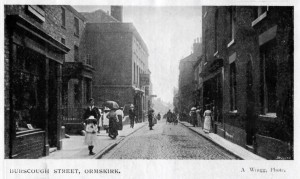
Image 1 – A picture by Alfred Wragg looking down Burscough Street towards the clock tower from his photography studio
The first image (Image 1) shows the exterior of Alfred’s studio at 30 Burscough Street around 1905. Looking towards the clock, number 28 and the next building, number 26, is the old Ormskirk Hall, the residence for many decades of doctor’s practices, including that of Dr Marsden who was tragically killed in a flying accident in 1946. Ormskirk Hall was a large Georgian style double fronted three storey town house with a grand portico entrance supported by twin columns (Image 2). No 28 after the demolition of Ormskirk Hall became Soundsgood Records in 1975 when the Wheatsheaf Walk development was completed.

Image 2 – Ormskirk Hall located between Alfred Wragg’s photography studio and The Wheatsheaf on Burscough Street
Evans and Ball had begun their wholesale grocery business at No 32, the other side of Wragg’s studio, but between 1895 and 1901 they took over No 22 Burscough Street and their operation thrived, they remained there into the 1960s.
Immediately after Evans & Ball’s warehouse stood the Wheatsheaf Hotel. This was another Georgian building with an entrance to their rear/side yard. A coach and horse had to negotiate a tight turn to pull out of the yard into the narrow street. The Wheatsheaf staircase was apparently one of the finest examples of Georgian wrought iron work in England. The Wheatsheaf was demolished in the mid 1960s to make way for the new development that took it’s name, Wheatsheaf Walk. If you look at the picture of the Wheatsheaf, taken in c. 1962, (Image 3), almost opposite was Swarbricks Pork Butchers.

Image 3 – The Wheatsheaf on Burscough Street taken c. 1962
This short run of shops and businesses in just one of the streets of Ormskirk, contained so much valuable history of the town, we strive at Ormskirk Bygone Times to make that history more easily accessible to people and if you can contribute with local knowledge or photographs you can contact us here.
Royal Visits To Ormskirk
Royal Visits To Ormskirk
We don’t have to go too far back in time to find firm evidence of visits to Ormskirk by the Royal Family. In the Summer of 1885, Edward, Prince of Wales, later to become Edward VII, came to the town for a short visit to Lathom House.
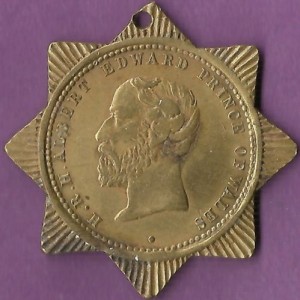
The medal that was struck to commemorate the visit of the Prince of Wales in 1885
To mark the occasion, as was the trend at the time, a commemorative medal was struck and made available as a souvenir of the visit. The town folk and dignitaries met the Prince’s train at Ormskirk Station, which had been newly painted, making the Royal party welcome with declarations of the support of the town for the Queen and the Royal Family. Around £350 was raised through subscription for the staging of an elaborate reception. At the Railway Station a 40ft x 30ft awning ‘upon polished pillars’ was erected and the Station approach right up to Derby Street was festooned with garlands and flowers, at the expense of the Lancashire & Yorkshire Railway Company.
Almost 3000 local school children were to be gathered in a suitable part of the town to collectively sing ‘God Bless The Prince Of Wales’ and in the evening the whole town was to be ‘illuminated’ at the expense of the local gas company. On his return to the station after his short stay at Lathom House, the main thoroughfare through the town, Moor Street, was thronged with well wishers.
It is probably during this visit, according to reports, that the Prince and Princess acquired a taste for Ormskirk Gingerbread.
Moving forward a few decades, the new King, George V, our own Queen’s grandfather, passes through the town on a tour of the Northern industrial towns of Lancashire. He is accompanied by Queen Mary, who can be clearly seen in the rear of the Royal car as it passes along Moor Street and drives into Church Street. The Steps of the King’s Arms give locals a vantage point from which to spot the Royal Couple.

Ormskirk residents watch on from the steps of the Kings Arms as King George V and Queen Mary drive past along Moor Street
In 1921, another Prince of Wales visits the town, the visit is recorded by the Ormskirk Advertiser and the Prince mixes with the veterans of the World War accompanied by the Earl of Lathom.

Ormskirk Advertiser Supplement to Commemorate The Visit of The Prince of Wales 1921. Click for a larger view.
The next visit to the town comes in 1945, when George VI and Queen Elizabeth, our present Queen’s parents, drive through the town along Moor Street with throngs of people lining the streets once again.
Moving into the 1960s, Royal visits to Edge Hill College, St Helens Road saw Princess Margaret opening a new wing at the College in 1962 and afterwards being driven through the town with hundreds of school children lining Moor Street to wave her past and Prince Philip has also visited the College.
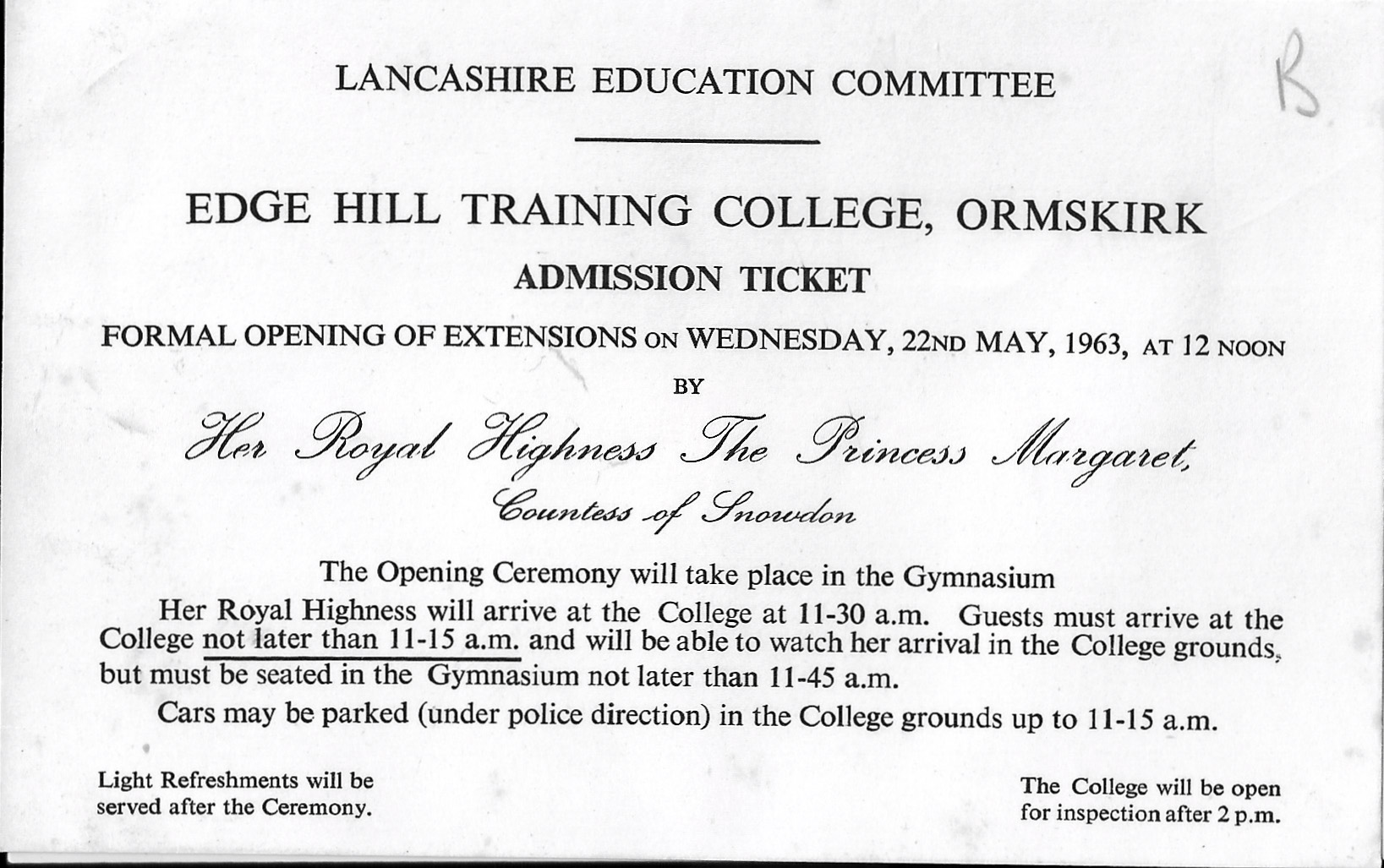
A ticket to the ceremony conducted by HRH Princess Margaret at Edge Hill College, 22nd May 1963. Click for a larger view
Ormskirk Bygone Times have accumulated a collection of photographs and new reports related to these Royal Visits and we would be interested in hearing from anyone with any pictures of Princess Margaret being driven through the town and also any pictures of the visit of The Prince and Princess of Wales, Charles and Diana, to Skelmersdale and Up Holland in the mid 1980s. If you can help us out at all you can contact us here.
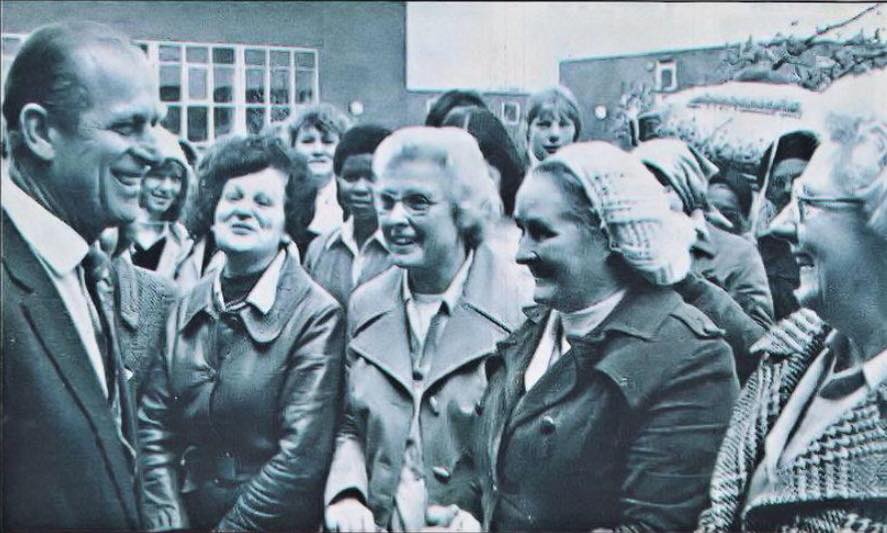
Prince Philip talks to Mable Jennings (in hat) during his visit to Edge Hill College
A Lusitania Survivor Visits Ormskirk

A Contemporary painting of RMS Lusitania by Odin Rosenvinge
A Lusitania Survivor Visits Ormskirk
On May 7th 1915 RMS Lusitania was sunk by a German U boat U20 off the southern coast of Ireland. Of the 1,960 souls on board bound for Liverpool from New York, 767 survived.
On that voyage was Sarah Lund nee Mounsey of Chicago Illinois and her husband and father. Sarah’s mother, Fanny Mounsey nee Sewell had been lost on the Empress of Ireland in the St Lawrence Seaway on May 29th 1914. Fanny Mounsey was travelling to visit family in Keswick, Cumberland at the time of the sinking of the Empress of Ireland and her body was never recovered.
A year later, Sarah Mounsey received a letter out of the blue at her home in Chicago from the Superintendant of the Ormskirk Union Workhouse, possibly Albert Horsfall Whittaker. An unidentified lady, in considerable distress, had been admitted to the workhouse in Wigan Road, Ormskirk and the poor wretched woman was only able to utter repeatedly the name ‘Mounsey’ and the letter went on to explain that this lady, known as ‘Kate Fitzgerald’ had a fear of water. For whatever reason, a link was made to the Empress of Ireland sinking a year earlier and the Superintendant sent a letter to Sarah, (who knows how he sought out her address) asking if this might be her mother.
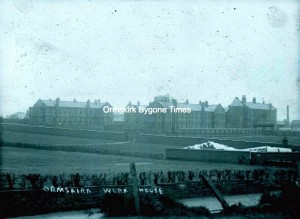
Ormskirk Workhouse as it was around the time of Sarah Lund’s visit
Sarah immediately left her home, with her husband and father to travel to Ormskirk, via New York and Liverpool, aboard the ill-fated Lusitania with the aim of meeting this mysterious lady. Fate intervened and Sarah, though suffering the terror of being flung into the sea as the ship exploded and being showered with debris was, after several hours in the water, pulled into a lifeboat.
Sarah lost her husband of just 1 year , and her father that day, she spent time in Queenstown, Ireland recovering but insisted on pressing on to Liverpool and then Ormskirk to meet the woman she was praying, now more than ever, was indeed her missing Mother, Fanny Mounsey.
Sadly, that was not to be, the lady in the workhouse was nothing like Sarah’a dear mother and Sarah was forced to return home to Chicago a widow, and without either parent.
Sarah did re-marry and lived until 1978, dying aged 92.
A tragic story amongst a tragic event.
Market Cross or Horology Square?
Market Cross or Horology Square?
In the years before the Ormskirk Clock Tower was erected in 1876, there had been nothing to identify the spot but the name Market Cross. No structure or marker has been in situ for generations. The name may even derive from the road system and there may never have been an actual cross there at all. Certainly when tenders were invited for the design and build of the tower, one local whit wrote to the Advertiser suggesting, ‘ Surely the archives of our semi-fossilised Court Leet would throw some light on the architectural form of this ancient Cross, and if no member of that venerable body is of an antiquarian turn of mind, they might mortify the flesh by denying themselves the periodical dinners, and divert the proceeds to employ a gentleman with a taste for routing amongst what Carlyle called their “dry-as-dust “ accumulations……’
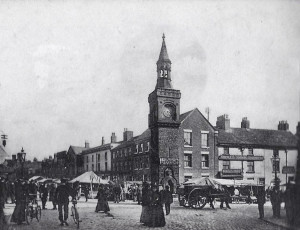 Market Place was used as the address for the businesses on each corner. In the 1820s, Bookseller Wm Leak’s printers and circulating library was at the corner of Aughton Street and Moor Street, with the George & Dragon on the corner of Church Street and Aughton Street , the Eagle & Child at the corner of Church Street and Burscough Street and Owen’s Ironmongers on the corner of Burscough Street and Moor Street.
The width of Moor Street merging with the narrowness of Church Street isn’t really an issue in modern times, but for those who remember the through traffic, especially on Market Days or coupled with Southport Flower Show, will truly know the meaning of traffic congestion. Add that to the traffic lights at the clock and buses or Westbrook Lorries turning into and up from Aughton Street, it was a risky place to cross at any time.
Some of the businesses used the Market Cross address into the 1900s, Mawdsleys famous gingerbread bakers just used ‘The Cross’ as their address.
HP Radio on the corner of Moor Street and Burscough Street. Photograph courtesy of the Gallagher family
The George & Dragon became the National Westminster bank, The Eagle & Child became Stoners, then Kirk’s, then briefly Lawrence’s butchers and was for many years Johnson’s the cleaners when the business moved from Moor Street.
Owen’s Ironmongers became Pennington’s Tailors in the early 1900s, it was HP Radio for a good while, Collingwood Jewellers in the 80s and then H. Samuels.
Martin’s Bank held it’s position for many years and the building has remained a bastian of financial service to the town.
Images before the Clock Tower are pretty rare but one day something may turn up.